

- Market Size (2026)
- USD 128.6 Bn
- Forecast (2036)
- USD 230.3 Bn
- CAGR (2026 to 2036)
- 6.0%
Toy Market Size, Market Forecast and Outlook By FMI
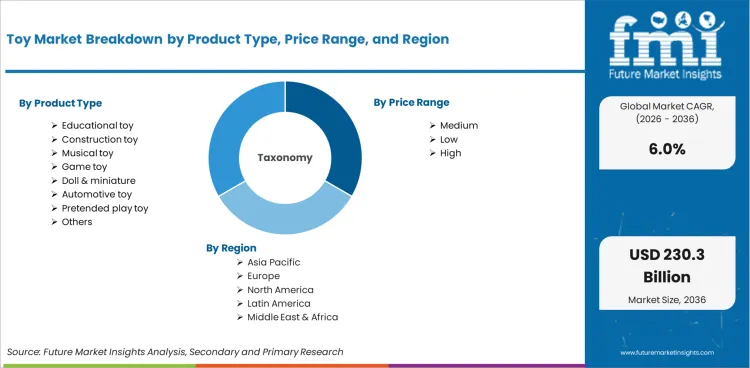
The toy market was valued at USD 121.3 billion in 2025. The market is set to reach USD 128.6 billion by 2026-end and grow at a CAGR of 6.0% between 2026-2036 to reach USD 230.3 billion by 2036. Educational toy will dominate with a 27.0% share, while Medium will lead with a 46.0%% share.
Summary of the Toy Market
- Demand and Growth Drivers
- Rising disposable incomes in emerging markets and growing child populations in South Asia and Africa are expanding the global toy consumption base.
- Parental investment in educational and developmental toys reflects the growing emphasis on STEM learning, cognitive development, and creativity building through structured play.
- E-commerce and direct to consumer channels are expanding toy market access, enabling smaller brands and specialty products to reach consumers beyond traditional retail distribution.
- Product and Segment View
- Educational toys are expected to account for 27.0% in 2026, reflecting parental demand for toys that combine entertainment with learning and development functions.
- Medium price range is expected to represent 46.0%, reflecting the sweet spot between affordability and perceived quality that captures the largest consumer spending segment.
- Sustainable materials including wooden, biodegradable, and recycled plastic toys are gaining market share as environmental awareness influences parental purchasing decisions.
- Geography and Competitive Outlook
- China is expected to lead growth at 8.1%, reflecting its massive child population, rising household spending on children, and toy manufacturing leadership.
- India at 7.5% reflects its large young population, growing middle class, and increasing organized retail and e-commerce toy distribution.
- Companies combining strong brand portfolios, innovation capability, and multi-channel distribution across physical retail and e-commerce are positioned to capture global toy demand.
- Analyst Opinion
- The toy market is shaped by the intersection of demographic trends, parental investment in child development, and the increasing influence of digital engagement on physical toy design.
- Adoption of educational and STEM toys reflects the global parenting trend toward purposeful play that delivers developmental benefits alongside entertainment value.
- Growth at 6.0% CAGR reflects emerging market consumption expansion, educational toy premiumization, and the resilience of physical toy demand despite digital entertainment competition.
- Companies investing in sustainable materials, educational content integration, and hybrid physical-digital play experiences are positioned to capture the growing premium toy segment.
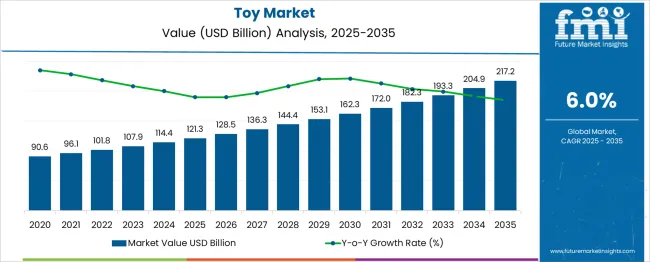
Key Takeaways, Market Size, and Forecast
- The toy market was valued at USD Billion 122 billion in 2025.
- By 2036, the Toy Market is expected to be worth USD Billion 230.26 billion.
- From 2026 to 2036, the market is projected to expand at a CAGR of 6.0%.
- The market is projected to create an incremental opportunity of USD Billion 101.68 billion between 2026 and 2036.
- In 2026, educational toy is expected to account for 27.0% of the product type segment, driven by growing parental emphasis on learning-through-play and STEM education that drives demand for toys combining entertainment with cognitive development, problem solving, and creativity building functions.
- China (8.1%) and India (7.5%) are two of the fastest growing markets in the world.
Toy Market Definition
The toy market covers products designed for children's play, entertainment, education, and development across educational, construction, musical, game, doll, automotive, pretended play, and other toy categories. Products span plastic, wooden, metal, fabric, and biodegradable materials across low, medium, and high price ranges for age groups from infant through adolescent, sold for individual and commercial use.
Toy Market Inclusions
Market scope includes all commercially traded toy products categorized by product type (educational, construction, musical, game, doll and miniature, automotive, pretended play, others), price range (low, medium, high), age group (below 1 year, 1 to 3, 3 to 5, 5 to 12, 12+), material (plastic, wooden, metal, fabric, biodegradable/organic), and end use (individual, commercial). Revenue coverage spans 2026 to 2036.
Toy Market Exclusions
The scope does not include video game consoles and software, mobile apps and digital games, sporting goods, children's furniture, or baby care products without play function.
Toy Market Research Methodology
- Primary Research: FMI analysts conducted interviews with manufacturers, technology specialists, and procurement professionals across key markets.
- Desk Research: Combined data from industry associations, regulatory bodies, and manufacturer disclosures.
- Market Sizing and Forecasting: Bottom up methodology aggregating segment and regional data with adoption velocity projections.
- Data Validation: Cross checked quarterly against production data, trade statistics, and manufacturer reporting.
Why is the Toy Market Growing?
- Rising household incomes in China, India, and Southeast Asia are expanding toy spending per child, creating volume and value growth across all toy categories.
- STEM education emphasis is driving parental investment in educational and construction toys that deliver learning outcomes through structured play experiences.
- Sustainability consciousness is reshaping toy material preferences, with wooden, recycled plastic, and biodegradable options gaining share from conventional plastic toys.
Demand for toys is driven by the global child population, household spending power, and parental attitudes toward play and development. Emerging markets with large child populations and rising incomes represent the primary growth opportunity. Per capita toy spending in China and India remains below developed market levels, indicating significant growth potential as household discretionary spending increases.
Educational toy demand reflects the structural shift in parenting toward purposeful play. Parents increasingly seek toys that develop cognitive skills, creativity, problem solving, and STEM literacy alongside entertainment. This creates premium pricing opportunity for toys with clear educational value propositions. Construction toys (Lego), coding/robotics toys, and science experiment kits represent the fastest growing educational subcategories.
Sustainability is emerging as a material differentiator. Environmental awareness among parents is driving demand for toys made from sustainably sourced wood, recycled plastics, and biodegradable materials. Major manufacturers including Lego and Mattel are investing in sustainable material transitions, while smaller brands are building market positions on eco-friendly toy manufacturing credentials.
Market Segmentation Analysis
- Educational toys represent 27.0% reflecting parental emphasis on learning-through-play and STEM development.
- Medium price range accounts for 46.0%, capturing the largest consumer segment between affordability and perceived quality.
- Sustainable material toys are the fastest growing material category driven by parental environmental awareness.
The toy market segments by product type, price range, age group, material, and end use. By product type, the market covers educational, construction, musical, game, doll, automotive, pretended play, and others.
Insights into the Educational Toy Product Type Segment
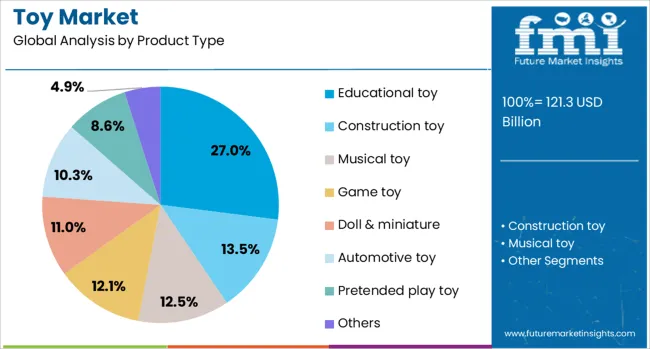
In 2026, educational toys are expected to account for 27.0% of the segment. The category includes STEM construction sets, coding and robotics kits, science experiment sets, language learning toys, and cognitive development products. Parental willingness to pay premium prices for toys with demonstrated educational value supports higher average selling prices compared to entertainment-only categories.
Insights into the Medium Price Range Segment
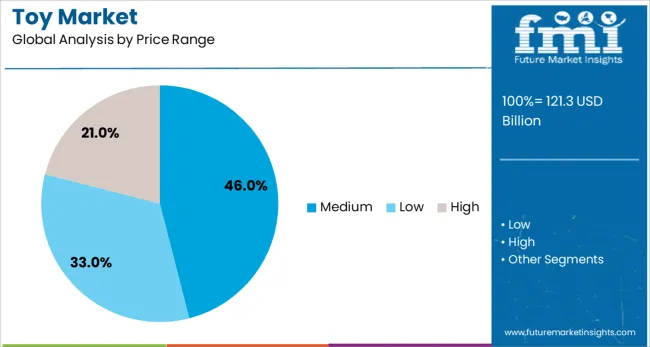
Medium price range is expected to represent 46.0% in 2026. Products in this tier provide perceived quality and durability that justify spending above low-cost imports while remaining accessible to middle-income households. This price segment captures the broadest consumer base across developed and emerging markets.
Toy Market Drivers, Restraints, and Opportunities
- Emerging market demographic and income growth create expanding toy consumption that drives both volume and value market expansion.
- Digital entertainment competition from tablets, smartphones, and gaming consumes children's attention and discretionary spending, creating competitive pressure on physical toys.
- Sustainable material development and educational content integration create premium differentiation opportunities.
The toy market is expanding at 6.0% CAGR driven by demographic growth, educational premiumization, and emerging market expansion. Digital competition creates pressure, while sustainability and education create differentiation.
Emerging Market Growth
Rising incomes and large child populations in China, India, and Southeast Asia create expanding toy demand. Per capita spending growth as households move into middle-income brackets drives market expansion.
Digital Entertainment Competition
Smartphones, tablets, and video games compete for children's time and household spending. Physical toy manufacturers respond with digital-physical hybrid products that integrate app connectivity and augmented reality.
Sustainability Differentiation
Wooden, recycled plastic, and biodegradable material toys create market differentiation as parental environmental awareness influences purchasing. Sustainability credentials support premium pricing.
Educational Content Integration
Toys incorporating STEM learning, coding, and creative development content command price premiums and parental preference, creating value growth in the educational segment.
Analysis of Toy Market By Key Countries
.webp "Top Country Growth Comparison Toy Market Cagr (2026 2036)")
| Country | CAGR |
|---|---|
| China | 8.1% |
| India | 7.5% |
| Germany | 6.9% |
| France | 6.3% |
| UK | 5.7% |
| USA | 5.1% |
| Brazil | 4.5% |
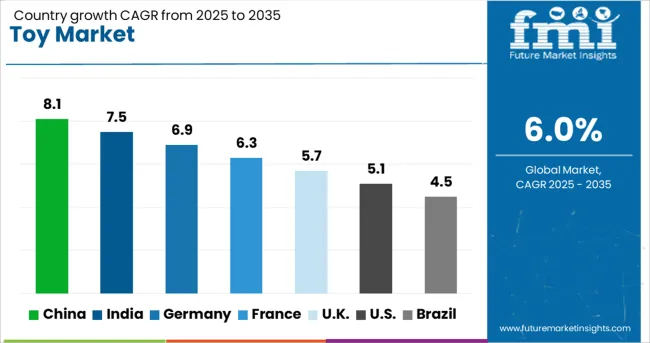
- China leads at 8.1% CAGR through 2036.
- India leads at 7.5% CAGR through 2036.
- Germany leads at 6.9% CAGR through 2036.
- France leads at 6.3% CAGR through 2036.
The global toy market is projected to grow at a CAGR of 6.0% from 2026 to 2036. The analysis covers more than 30 countries, with the leading markets detailed below.
Demand Outlook for Toy Market in China
China is expected to lead growth at 8.1% through 2036, reflecting its large child population, rising household spending, and domestic toy manufacturing leadership.
- Large child population creates substantial consumption base.
- Rising household spending increases per-child toy expenditure.
- Domestic manufacturing leadership supports local brand development.
Future Outlook for Toy Market in India
India is expected to grow at 7.5% through 2036, supported by its massive young population, growing middle class, and expanding organized toy retail and e-commerce.
- Large young population creates growing toy consumer base.
- Middle class expansion increases discretionary toy spending.
- E-commerce growth expands toy distribution reach.
Opportunity Analysis of Toy Market in Germany
Germany is expected to grow at 6.9% through 2036, reflecting its toy manufacturing heritage, quality standards, and strong educational toy demand.
- Toy manufacturing heritage supports premium brand positioning.
- Quality standards drive demand for durable, safe toy products.
- Educational toy demand supports STEM and learning product growth.
In-depth Analysis of Toy Market in the United States
The USA is expected to grow at 5.1% through 2036, reflecting its large toy market, established brand consumption, and growing educational toy investment.
- Large established market supports high per-capita toy spending.
- Brand loyalty creates stable demand for major toy manufacturers.
- Educational toy investment drives premium segment growth.
Sales Analysis of Toy Market in the United Kingdom
The UK is expected to grow at 5.7% through 2036, supported by its toy retail market, licensing driven demand, and growing sustainable toy adoption.
- Toy retail market supports diverse product distribution.
- Licensing drives demand for entertainment-linked toy products.
- Sustainable toy adoption creates eco-friendly market segment.
Demand Outlook for Toy Market in France
France is expected to grow at 6.3% through 2036, reflecting its toy market, educational emphasis, and growing e-commerce toy distribution.
- Toy market supports diverse product category demand.
- Educational emphasis drives learning toy investment.
- E-commerce distribution expands toy accessibility.
Competitive Landscape and Strategic Positioning
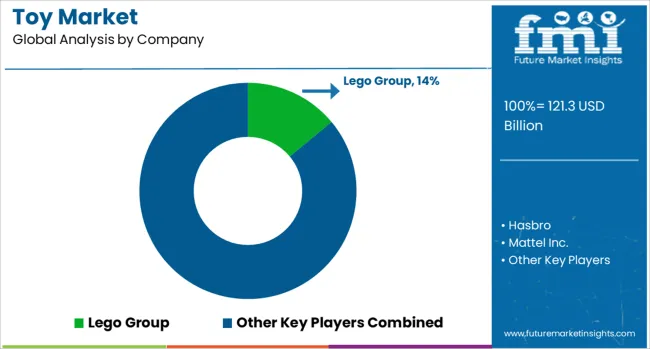
- Lego Group leads the market with comprehensive product and service capabilities and established customer relationships.
- Multiple global and regional players compete on technology capability, certification credentials, and geographic reach.
- Emerging players are targeting specialized applications and next generation technology development.
Lego Group leads the global toy market through its construction toy system, educational product expansion, and strong brand loyalty across age groups. Hasbro and Mattel maintain comprehensive toy portfolios spanning action figures, dolls, games, and licensed entertainment properties.
Bandai Namco and TOMY serve Asian and global markets with character-based toys and entertainment integration. Spin Master provides innovation-driven toy products across multiple categories.
MGA Entertainment, Playmobil, and Simba Dickie Group serve global markets with diverse toy portfolios. Playmobil and Simba Dickie maintain strong European market positions.
Key Companies in the Toy Market
Key global companies leading the toy market include:
- Lego Group (Denmark), Hasbro (USA), Mattel Inc. (USA), Bandai Namco Holdings Inc. (Japan), Spin Master (Canada) hold strong positions through manufacturing scale, certification credentials, and established customer relationships.
- MGA Entertainment (USA), Playmobil (Germany), TOMY (Japan), Simba Dickie Group (Germany) are expanding presence through regional focus and specialized product development.
Competitive Benchmarking: Toy Market
| Company | Brand Portfolio | Innovation Pipeline | Distribution Network | Geographic Reach |
|---|---|---|---|---|
| Lego Group | High | High | Strong | Global |
| Hasbro | High | High | Strong | Global |
| Mattel Inc. | High | High | Strong | Global |
| Bandai Namco | High | High | Strong | Asia, Global |
| Spin Master | High | High | Strong | North America, Global |
| MGA Entertainment | High | High | Strong | Global |
| Playmobil | High | High | Strong | Europe, Global |
| TOMY | High | High | Strong | Asia, Global |
| Simba Dickie Group | High | High | Strong | Europe, Global |
Source: Future Market Insights competitive analysis, 2026.
Key Players in the Toy Market
Major Global Players
- Lego Group (Denmark)
- Hasbro (USA)
- Mattel Inc. (USA)
- Bandai Namco Holdings Inc. (Japan)
- Spin Master (Canada)
Emerging Players/Startups
- MGA Entertainment (USA)
- Playmobil (Germany)
- TOMY (Japan)
- Simba Dickie Group (Germany)
Report Scope and Coverage
| Parameter | Details |
|---|---|
| Quantitative Units | USD Billion 128.58 to USD Billion 230.26, at a CAGR of 6.0% |
| Market Definition | The toy market covers products designed for children's play, entertainment, education, and development across educational, construction, musical, game, doll, automotive, pretended play, and other toy categories. Products span plastic, wooden, metal, fabric, and biodegradable materials across low, medium, and high price ranges for age groups from infant through adolescent, sold for individual and commercial use. |
| Regions Covered | North America, Latin America, Europe, East Asia, South Asia and Pacific, Middle East and Africa |
| Countries Covered | China, India, Germany, France, UK, USA, Brazil, and 30 plus countries |
| Key Companies Profiled | Lego Group, Hasbro, Mattel Inc., Bandai Namco Holdings Inc., Spin Master, MGA Entertainment, Playmobil, TOMY |
| Forecast Period | 2026 to 2036 |
| Approach | Hybrid bottom up and top down methodology starting with verified transaction data, projecting adoption velocity across segments and regions. |
Segmentation
Toy Market Segmented by Product Type:
- Educational toy
- Construction toy
- Musical toy
- Game toy
- Doll & miniature
- Automotive toy
- Pretended play toy
- Others
Toy Market Segmented by Price Range:
- Medium
- Low
- High
Toy Market Segmented by Age Group:
- Age 5-12
- Below 1 Yrs.
- Age 1-3
- Age 3-5
- Age 12+
Toy Market Segmented by Material:
- Plastic
- Wooden
- Metal
- Fabric
- Biodegradable/Organic Materials
Toy Market Segmented by End Use:
- Individual
- Commercial
Toy Market by Region:
- North America
- USA
- Canada
- Mexico
- Latin America
- Brazil
- Chile
- Rest of Latin America
- Western Europe
- Germany
- UK
- Italy
- Spain
- France
- Nordic
- BENELUX
- Rest of Western Europe
- Eastern Europe
- Russia
- Poland
- Hungary
- Balkan & Baltic
- Rest of Eastern Europe
- East Asia
- China
- Japan
- South Korea
- South Asia and Pacific
- India
- ASEAN
- Australia & New Zealand
- Rest of South Asia and Pacific
- Middle East & Africa
- Kingdom of Saudi Arabia
- Other GCC Countries
- Turkiye
- South Africa
- Other African Union
- Rest of Middle East & Africa
Research Sources and Bibliography
- 1. NPD Group / Circana. (2025). Global Toy Industry Market Report and Category Analysis. Circana.
- 2. Toy Association. (2024). USA Toy Industry Annual Report and Market Statistics. Toy Association.
- 3. British Toy and Hobby Association. (2025). BTHA UK Toy Market Report. BTHA.
- 4. UNICEF. (2024). UNICEF Report: Learning Through Play, Global Perspectives on Early Childhood Development. UNICEF.
- 5. International Council of Toy Industries. (2025). ICTI World Toy Industry Facts and Figures. ICTI.
This bibliography is provided for reader reference. The full Future Market Insights report contains the complete reference list.
This Report Answers
- Estimating the size of the market and projected revenue from 2026 to 2036.
- Segmentation by product type, price range, age group, material, end use, and region.
- Insights across more than 30 country markets.
- Analysis of educational toy, sustainability, and digital-physical hybrid trends.
- Assessment of the competitive landscape and manufacturer positioning.
- Identification of investment opportunities in STEM toys, sustainable materials, and emerging market expansion.
- Tracking consumer behavior and parental purchasing trend developments.
- Delivery of data in PDF and Excel formats.
Frequently Asked Questions
What is the global market demand for Toy in 2026?
In 2026, the global toy market is expected to be worth USD Billion 128.58 billion.
How big will the Toy Market be in 2036?
By 2036, the toy market is expected to be worth USD Billion 230.26 billion.
How much is demand for Toy expected to grow between 2026 and 2036?
Between 2026 and 2036, demand is expected to grow at a CAGR of 6.0%.
Which product type segment is expected to lead in 2026?
Educational toy is expected to account for 27.0% of the product type segment in 2026, driven by growing parental emphasis on learning-through-play and STEM education that drives demand for toys combining entertainment with cognitive development, problem solving, and creativity building functions.
What is causing demand to rise in China?
China is expected to grow at 8.1% CAGR through 2036. Large child population creates substantial consumption base.
What is causing demand to rise in India?
India is expected to grow at 7.5% CAGR through 2036. Large young population creates growing toy consumer base.
What does this report mean by 'Toy Market definition'?
The toy market covers products designed for children's play, entertainment, education, and development across educational, construction, musical, game, doll, automotive, pretended play, and other toy categories. Products span plastic, wooden, metal, fabric, and biodegradable materials across low, medium, and high price ranges for age groups from infant through adolescent, sold for individual and commercial use.
How does FMI make the Toy forecast and validate it?
Forecasting models use a hybrid bottom up and top down approach, starting with verified transaction data and validating against industry production statistics and manufacturer disclosures.
Preview the report firsthand - request a free sample
Get SampleGet the brochure for pricing and purchase details.
Get PDFTable of Content
- Executive Summary
- Global Market Outlook
- Demand-side Trends
- Supply-side Trends
- Technology Roadmap Analysis
- Analysis and Recommendations
- Market Overview
- Market Coverage / Taxonomy
- Market Definition / Scope / Limitations
- Research Methodology
- Chapter Orientation
- Analytical Lens and Working Hypotheses
- Market Structure, Signals, and Trend Drivers
- Benchmarking and Cross-market Comparability
- Market Sizing, Forecasting, and Opportunity Mapping
- Research Design and Evidence Framework
- Desk Research Programme (Secondary Evidence)
- Company Annual and Sustainability Reports
- Peer-reviewed Journals and Academic Literature
- Corporate Websites, Product Literature, and Technical Notes
- Earnings Decks and Investor Briefings
- Statutory Filings and Regulatory Disclosures
- Technical White Papers and Standards Notes
- Trade Journals, Industry Magazines, and Analyst Briefs
- Conference Proceedings, Webinars, and Seminar Materials
- Government Statistics Portals and Public Data Releases
- Press Releases and Reputable Media Coverage
- Specialist Newsletters and Curated Briefings
- Sector Databases and Reference Repositories
- FMI Internal Proprietary Databases and Historical Market Datasets
- Subscription Datasets and Paid Sources
- Social Channels, Communities, and Digital Listening Inputs
- Additional Desk Sources
- Expert Input and Fieldwork (Primary Evidence)
- Primary Modes
- Qualitative Interviews and Expert Elicitation
- Quantitative Surveys and Structured Data Capture
- Blended Approach
- Why Primary Evidence is Used
- Field Techniques
- Interviews
- Surveys
- Focus Groups
- Observational and In-context Research
- Social and Community Interactions
- Stakeholder Universe Engaged
- C-suite Leaders
- Board Members
- Presidents and Vice Presidents
- R&D and Innovation Heads
- Technical Specialists
- Domain Subject-matter Experts
- Scientists
- Physicians and Other Healthcare Professionals
- Governance, Ethics, and Data Stewardship
- Research Ethics
- Data Integrity and Handling
- Primary Modes
- Tooling, Models, and Reference Databases
- Desk Research Programme (Secondary Evidence)
- Data Engineering and Model Build
- Data Acquisition and Ingestion
- Cleaning, Normalisation, and Verification
- Synthesis, Triangulation, and Analysis
- Quality Assurance and Audit Trail
- Market Background
- Market Dynamics
- Drivers
- Restraints
- Opportunity
- Trends
- Scenario Forecast
- Demand in Optimistic Scenario
- Demand in Likely Scenario
- Demand in Conservative Scenario
- Opportunity Map Analysis
- Product Life Cycle Analysis
- Supply Chain Analysis
- Investment Feasibility Matrix
- Value Chain Analysis
- PESTLE and Porter’s Analysis
- Regulatory Landscape
- Regional Parent Market Outlook
- Production and Consumption Statistics
- Import and Export Statistics
- Market Dynamics
- Global Market Analysis 2021 to 2025 and Forecast, 2026 to 2036
- Historical Market Size Value (USD Million) Analysis, 2021 to 2025
- Current and Future Market Size Value (USD Million) Projections, 2026 to 2036
- Y-o-Y Growth Trend Analysis
- Absolute $ Opportunity Analysis
- Global Market Pricing Analysis 2021 to 2025 and Forecast 2026 to 2036
- Global Market Analysis 2021 to 2025 and Forecast 2026 to 2036, By Product Type
- Introduction / Key Findings
- Historical Market Size Value (USD Million) Analysis By Product Type , 2021 to 2025
- Current and Future Market Size Value (USD Million) Analysis and Forecast By Product Type , 2026 to 2036
- Educational toy
- Construction toy
- Musical toy
- Game toy
- Doll & miniature
- Automotive toy
- Pretended play toy
- Others
- Educational toy
- Y-o-Y Growth Trend Analysis By Product Type , 2021 to 2025
- Absolute $ Opportunity Analysis By Product Type , 2026 to 2036
- Global Market Analysis 2021 to 2025 and Forecast 2026 to 2036, By Price Range
- Introduction / Key Findings
- Historical Market Size Value (USD Million) Analysis By Price Range, 2021 to 2025
- Current and Future Market Size Value (USD Million) Analysis and Forecast By Price Range, 2026 to 2036
- Medium
- Low
- High
- Medium
- Y-o-Y Growth Trend Analysis By Price Range, 2021 to 2025
- Absolute $ Opportunity Analysis By Price Range, 2026 to 2036
- Global Market Analysis 2021 to 2025 and Forecast 2026 to 2036, By Age Group
- Introduction / Key Findings
- Historical Market Size Value (USD Million) Analysis By Age Group, 2021 to 2025
- Current and Future Market Size Value (USD Million) Analysis and Forecast By Age Group, 2026 to 2036
- Age 5–12
- Below 1 Yrs.
- Age 1–3
- Age 3–5
- Age 12+
- Age 5–12
- Y-o-Y Growth Trend Analysis By Age Group, 2021 to 2025
- Absolute $ Opportunity Analysis By Age Group, 2026 to 2036
- Global Market Analysis 2021 to 2025 and Forecast 2026 to 2036, By Material
- Introduction / Key Findings
- Historical Market Size Value (USD Million) Analysis By Material, 2021 to 2025
- Current and Future Market Size Value (USD Million) Analysis and Forecast By Material, 2026 to 2036
- Plastic
- Wooden
- Metal
- Fabric
- Biodegradable/Organic Materials
- Plastic
- Y-o-Y Growth Trend Analysis By Material, 2021 to 2025
- Absolute $ Opportunity Analysis By Material, 2026 to 2036
- Global Market Analysis 2021 to 2025 and Forecast 2026 to 2036, By End Use
- Introduction / Key Findings
- Historical Market Size Value (USD Million) Analysis By End Use, 2021 to 2025
- Current and Future Market Size Value (USD Million) Analysis and Forecast By End Use, 2026 to 2036
- Individual
- Commercial
- Individual
- Y-o-Y Growth Trend Analysis By End Use, 2021 to 2025
- Absolute $ Opportunity Analysis By End Use, 2026 to 2036
- Global Market Analysis 2021 to 2025 and Forecast 2026 to 2036, By Region
- Introduction
- Historical Market Size Value (USD Million) Analysis By Region, 2021 to 2025
- Current Market Size Value (USD Million) Analysis and Forecast By Region, 2026 to 2036
- North America
- Latin America
- Western Europe
- Eastern Europe
- East Asia
- South Asia and Pacific
- Middle East & Africa
- Market Attractiveness Analysis By Region
- North America Market Analysis 2021 to 2025 and Forecast 2026 to 2036, By Country
- Historical Market Size Value (USD Million) Trend Analysis By Market Taxonomy, 2021 to 2025
- Market Size Value (USD Million) Forecast By Market Taxonomy, 2026 to 2036
- By Country
- USA
- Canada
- Mexico
- By Product Type
- By Price Range
- By Age Group
- By Material
- By End Use
- By Country
- Market Attractiveness Analysis
- By Country
- By Product Type
- By Price Range
- By Age Group
- By Material
- By End Use
- Key Takeaways
- Latin America Market Analysis 2021 to 2025 and Forecast 2026 to 2036, By Country
- Historical Market Size Value (USD Million) Trend Analysis By Market Taxonomy, 2021 to 2025
- Market Size Value (USD Million) Forecast By Market Taxonomy, 2026 to 2036
- By Country
- Brazil
- Chile
- Rest of Latin America
- By Product Type
- By Price Range
- By Age Group
- By Material
- By End Use
- By Country
- Market Attractiveness Analysis
- By Country
- By Product Type
- By Price Range
- By Age Group
- By Material
- By End Use
- Key Takeaways
- Western Europe Market Analysis 2021 to 2025 and Forecast 2026 to 2036, By Country
- Historical Market Size Value (USD Million) Trend Analysis By Market Taxonomy, 2021 to 2025
- Market Size Value (USD Million) Forecast By Market Taxonomy, 2026 to 2036
- By Country
- Germany
- UK
- Italy
- Spain
- France
- Nordic
- BENELUX
- Rest of Western Europe
- By Product Type
- By Price Range
- By Age Group
- By Material
- By End Use
- By Country
- Market Attractiveness Analysis
- By Country
- By Product Type
- By Price Range
- By Age Group
- By Material
- By End Use
- Key Takeaways
- Eastern Europe Market Analysis 2021 to 2025 and Forecast 2026 to 2036, By Country
- Historical Market Size Value (USD Million) Trend Analysis By Market Taxonomy, 2021 to 2025
- Market Size Value (USD Million) Forecast By Market Taxonomy, 2026 to 2036
- By Country
- Russia
- Poland
- Hungary
- Balkan & Baltic
- Rest of Eastern Europe
- By Product Type
- By Price Range
- By Age Group
- By Material
- By End Use
- By Country
- Market Attractiveness Analysis
- By Country
- By Product Type
- By Price Range
- By Age Group
- By Material
- By End Use
- Key Takeaways
- East Asia Market Analysis 2021 to 2025 and Forecast 2026 to 2036, By Country
- Historical Market Size Value (USD Million) Trend Analysis By Market Taxonomy, 2021 to 2025
- Market Size Value (USD Million) Forecast By Market Taxonomy, 2026 to 2036
- By Country
- China
- Japan
- South Korea
- By Product Type
- By Price Range
- By Age Group
- By Material
- By End Use
- By Country
- Market Attractiveness Analysis
- By Country
- By Product Type
- By Price Range
- By Age Group
- By Material
- By End Use
- Key Takeaways
- South Asia and Pacific Market Analysis 2021 to 2025 and Forecast 2026 to 2036, By Country
- Historical Market Size Value (USD Million) Trend Analysis By Market Taxonomy, 2021 to 2025
- Market Size Value (USD Million) Forecast By Market Taxonomy, 2026 to 2036
- By Country
- India
- ASEAN
- Australia & New Zealand
- Rest of South Asia and Pacific
- By Product Type
- By Price Range
- By Age Group
- By Material
- By End Use
- By Country
- Market Attractiveness Analysis
- By Country
- By Product Type
- By Price Range
- By Age Group
- By Material
- By End Use
- Key Takeaways
- Middle East & Africa Market Analysis 2021 to 2025 and Forecast 2026 to 2036, By Country
- Historical Market Size Value (USD Million) Trend Analysis By Market Taxonomy, 2021 to 2025
- Market Size Value (USD Million) Forecast By Market Taxonomy, 2026 to 2036
- By Country
- Kingdom of Saudi Arabia
- Other GCC Countries
- Turkiye
- South Africa
- Other African Union
- Rest of Middle East & Africa
- By Product Type
- By Price Range
- By Age Group
- By Material
- By End Use
- By Country
- Market Attractiveness Analysis
- By Country
- By Product Type
- By Price Range
- By Age Group
- By Material
- By End Use
- Key Takeaways
- Key Countries Market Analysis
- USA
- Pricing Analysis
- Market Share Analysis, 2025
- By Product Type
- By Price Range
- By Age Group
- By Material
- By End Use
- Canada
- Pricing Analysis
- Market Share Analysis, 2025
- By Product Type
- By Price Range
- By Age Group
- By Material
- By End Use
- Mexico
- Pricing Analysis
- Market Share Analysis, 2025
- By Product Type
- By Price Range
- By Age Group
- By Material
- By End Use
- Brazil
- Pricing Analysis
- Market Share Analysis, 2025
- By Product Type
- By Price Range
- By Age Group
- By Material
- By End Use
- Chile
- Pricing Analysis
- Market Share Analysis, 2025
- By Product Type
- By Price Range
- By Age Group
- By Material
- By End Use
- Germany
- Pricing Analysis
- Market Share Analysis, 2025
- By Product Type
- By Price Range
- By Age Group
- By Material
- By End Use
- UK
- Pricing Analysis
- Market Share Analysis, 2025
- By Product Type
- By Price Range
- By Age Group
- By Material
- By End Use
- Italy
- Pricing Analysis
- Market Share Analysis, 2025
- By Product Type
- By Price Range
- By Age Group
- By Material
- By End Use
- Spain
- Pricing Analysis
- Market Share Analysis, 2025
- By Product Type
- By Price Range
- By Age Group
- By Material
- By End Use
- France
- Pricing Analysis
- Market Share Analysis, 2025
- By Product Type
- By Price Range
- By Age Group
- By Material
- By End Use
- India
- Pricing Analysis
- Market Share Analysis, 2025
- By Product Type
- By Price Range
- By Age Group
- By Material
- By End Use
- ASEAN
- Pricing Analysis
- Market Share Analysis, 2025
- By Product Type
- By Price Range
- By Age Group
- By Material
- By End Use
- Australia & New Zealand
- Pricing Analysis
- Market Share Analysis, 2025
- By Product Type
- By Price Range
- By Age Group
- By Material
- By End Use
- China
- Pricing Analysis
- Market Share Analysis, 2025
- By Product Type
- By Price Range
- By Age Group
- By Material
- By End Use
- Japan
- Pricing Analysis
- Market Share Analysis, 2025
- By Product Type
- By Price Range
- By Age Group
- By Material
- By End Use
- South Korea
- Pricing Analysis
- Market Share Analysis, 2025
- By Product Type
- By Price Range
- By Age Group
- By Material
- By End Use
- Russia
- Pricing Analysis
- Market Share Analysis, 2025
- By Product Type
- By Price Range
- By Age Group
- By Material
- By End Use
- Poland
- Pricing Analysis
- Market Share Analysis, 2025
- By Product Type
- By Price Range
- By Age Group
- By Material
- By End Use
- Hungary
- Pricing Analysis
- Market Share Analysis, 2025
- By Product Type
- By Price Range
- By Age Group
- By Material
- By End Use
- Kingdom of Saudi Arabia
- Pricing Analysis
- Market Share Analysis, 2025
- By Product Type
- By Price Range
- By Age Group
- By Material
- By End Use
- Turkiye
- Pricing Analysis
- Market Share Analysis, 2025
- By Product Type
- By Price Range
- By Age Group
- By Material
- By End Use
- South Africa
- Pricing Analysis
- Market Share Analysis, 2025
- By Product Type
- By Price Range
- By Age Group
- By Material
- By End Use
- USA
- Market Structure Analysis
- Competition Dashboard
- Competition Benchmarking
- Market Share Analysis of Top Players
- By Regional
- By Product Type
- By Price Range
- By Age Group
- By Material
- By End Use
- Competition Analysis
- Competition Deep Dive
- Lego Group
- Overview
- Product Portfolio
- Profitability by Market Segments (Product/Age /Sales Channel/Region)
- Sales Footprint
- Strategy Overview
- Marketing Strategy
- Product Strategy
- Channel Strategy
- Hasbro
- Mattel Inc.
- Bandai Namco Holdings Inc.
- Spin Master
- MGA Entertainment
- Playmobil
- TOMY
- Simba Dickie Group
- Lego Group
- Competition Deep Dive
- Assumptions & Acronyms Used


